
Forest compensation in Flanders: where it actually fails

Forest Forward Team
20-05-2026
•What boscompensatie actually requires in Flanders
Deforestation in Flanders is prohibited in principle. When it is permitted as an exception, the Agentschap voor Natuur en Bos (ANB) requires the developer to compensate for what is lost, either through compensation in natura (planting equivalent or greater forest area elsewhere) or through a financial bosbehoudsbijdrage. The Flemish Government raised that financial contribution to 5.6 euro per m² precisely because the previous rate had failed to keep pace with land prices for over two decades, leaving the 2001-2019 period chronically under-compensated.
That context matters for developers reading an environmental impact assessment (MER) for the first time. The system is not static, and the financial route is not a simple write-a-cheque solution. ANB evaluates both paths, and the ecological credibility of your compensation directly affects how smoothly your ontbossingsvergunning moves forward.
Why the system was already under pressure before your project started
The structural problem with boscompensatie in Flanders is not a secret. A 2023 BOS+ report documented that compensation has lagged behind actual deforestation for years, and that a meaningful share of required compensation never materialises as real, planted forest. A 2023 UHasselt analysis went further, concluding that current compensation ratios are insufficient to replace the ecological values that cleared forest actually held, and that the mechanism can actively encourage forest fragmentation and geographic displacement.
Then add the illegal deforestation problem. VRT NWS reported in 2025 that ANB recorded 140 hectares of unlicensed forest clearance in 2024 alone. When regularisation pathways exist that ultimately reduce to a compensation obligation, the signal to the market is that the system is navigable rather than strict. That increases demand for compensation land without increasing supply.
For a project developer, this means you are entering a market for suitable compensation land that is structurally tighter than it looks on paper. The land exists, but finding parcels that ANB will actually accept, at a price that fits your project economics, is the first operational chokepoint.
Where property developers specifically get stuck
We see this constantly in our work with project developers and omgevingscoördinatoren in Flanders: boscompensatie is treated as a late-stage administrative task rather than an early-stage project variable. By the time the MER flags a deforestation obligation and the vergunning application is in motion, the timeline is already compressed. That compression is where most failures originate.
The five failure points we observe most consistently:
1. Late integration into project planning. Compensation land cannot be found and contracted overnight. When the boscompensatie obligation surfaces only after the ruimtelijk uitvoeringsplan (RUP) is finalised and the stedenbouwkundige vergunning application is filed, developers are negotiating for land under time pressure, which means overpaying, accepting inferior parcels, or requesting timeline extensions that stall the whole project.
2. Land availability and suitability. Not every parcel is eligible. ANB has specific criteria around location, existing land use, ecological potential, and proximity to existing forest structures. Parcels close to urban development zones, which are the ones most easily accessible to developers, are often the least suitable ecologically and the most expensive commercially. Boscompenseren.be exists as a matching platform precisely because this search is genuinely difficult, but a marketplace listing is not the same as a vetted, permit-ready parcel.
3. Administrative complexity and data accuracy. The Belgian Court of Audit (Rekenhof) already flagged in 2016 that ANB's own databases contained inaccuracies in how deforestation decisions and compensation obligations were recorded. That creates real compliance risk: if the administrative trail between your cleared area, your compensation obligation, and your planted replacement forest is not precisely documented and correctly entered, you face follow-up problems that can reopen permitting questions you thought were closed.
4. Ecological quality of the compensation. Planting trees is not the same as creating forest. The UHasselt research is clear that compensation ratios in Flanders do not automatically replace the biodiversity, structural complexity, or hydrological function of mature forest. If your compensation planting uses the wrong species mix, ignores soil conditions, or produces a monoculture row planting, ANB's ecological assessment will reflect that, and so will any ESG disclosure your investors or buyers require.
5. Execution and monitoring after planting. The obligation does not end at planting. Survival rates, species composition, and long-term management commitments are part of what ANB evaluates. Developers who hand off the planting to a contractor with no ecological oversight often discover, sometimes years later, that their compensation does not hold up to scrutiny. That is a liability that follows the project, not just the permit application.
What this means for your building permit timeline
The honest answer is that boscompensatie, handled reactively, adds weeks to months to your permitting process. Handled proactively, it becomes a resolved line item before your vergunning application is submitted.
The practical difference comes down to when you start. Compensation land search, ANB pre-consultation, ecological design, and administrative preparation all need to begin at the project design phase, not after the MER is finalised. Developers who treat this as a parallel workstream rather than a downstream task consistently reach the permit stage with the compensation obligation already structured and documentable.
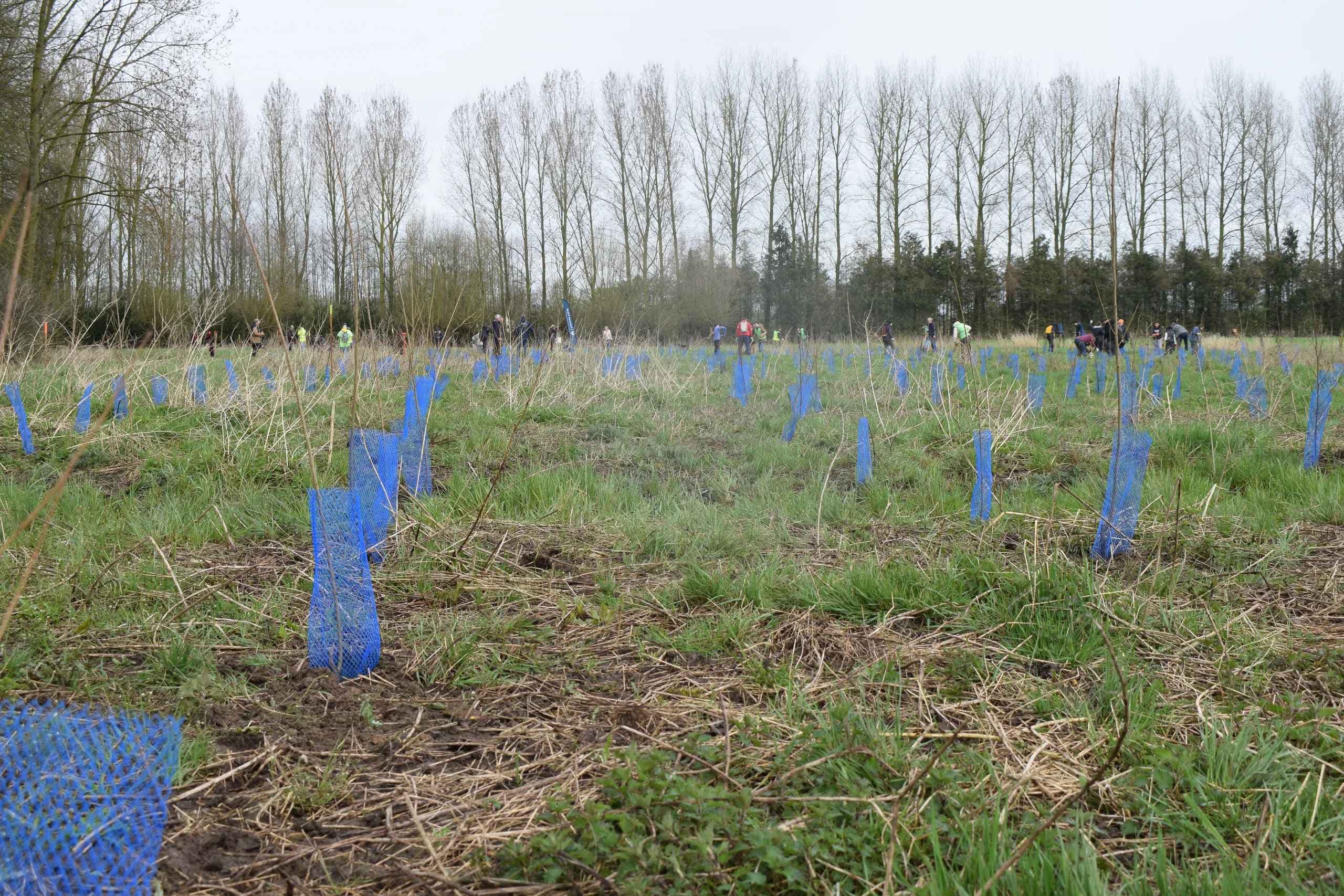
This is also where the green credentials argument becomes commercially relevant. Buyers and institutional investors are asking for concrete evidence of environmental commitments, not assurances. A properly executed boscompensatie, with native species planting, biodiversity monitoring, and documented ecological outcomes, is something you can actually show. Our end-to-end forest compensation service handles land sourcing, all legal and administrative procedures with ANB, ecological design with native species, and stakeholder engagement, so the compensation becomes an asset in your project narrative rather than a liability in your timeline.
How to stop losing weeks on boscompensatie paperwork
The developers who navigate this most efficiently do three things differently.
First, they commission the compensation trajectory at the same time as the MER, not after it. The MER tells you what you owe; the compensation search tells you whether you can deliver it. Running both in parallel eliminates the gap that stalls permits.
Second, they work with a partner who already has ANB relationships and knows which land typologies pass ecological review. The difference between a parcel that ANB accepts and one that requires revision rounds is almost never visible in a land registry search. It requires ecological and procedural knowledge that most in-house environmental coordinators simply do not have at this level of specialisation.
Third, they document the ecological quality of the compensation from day one, not as an afterthought. Native species composition, planting density, soil preparation, and a monitoring protocol give you something to show investors, buyers, and permitting authorities that a simple receipt for a financial contribution never can. For a broader look at how Forest Forward approaches nature creation across different project types, the full services overview covers the range of options available to developers and landowners.
Boscompensatie in Flanders fails on execution, not on intention, and the execution gap is entirely preventable if you treat the obligation as a project variable rather than a permitting formality. Knowing where the system breaks down means you can structure your timeline and your partner selection to avoid every one of those failure points. Talk to us about your forest compensation obligation and we will tell you within days what a compliant, ecologically sound, and permit-ready compensation trajectory looks like for your specific project.
Frequently asked questions
What is boscompensatie and when is it required in Flanders?
Boscompensatie is the legal obligation to compensate for forest cleared during development in Flanders. Deforestation is prohibited in principle under Flemish law. When an exception is granted via an ontbossingsvergunning, the developer must either plant equivalent or greater forest area elsewhere (compensation in natura) or pay a financial bosbehoudsbijdrage. The Agentschap voor Natuur en Bos oversees both routes and evaluates the ecological adequacy of the compensation.
Why is finding suitable compensation land so difficult in Flanders?
ANB applies specific ecological and locational criteria to compensation parcels. Land near urban development zones is often commercially overpriced and ecologically unsuitable. The supply of eligible parcels is structurally limited, and demand has increased partly because illegal deforestation regularisation pathways also feed into the compensation market. Platforms like Boscompenseren.be help with matching, but finding a parcel that passes ANB review requires specialist knowledge beyond a simple land search.
Can paying the financial bosbehoudsbijdrage replace compensation in natura?
Yes, but the financial route is not automatically simpler. The Flemish Government raised the bosbehoudsbijdrage to 5.6 euro per m² to reflect actual land acquisition costs. ANB still evaluates whether the financial contribution is appropriate given the ecological value of the cleared forest. For projects where green credentials matter to buyers or investors, the financial route also produces nothing tangible to communicate, which is an increasing commercial disadvantage.
How early in a project should boscompensatie be addressed?
The compensation trajectory should start at the same time as the milieueffectenrapport, not after it. Land search, ANB pre-consultation, ecological design, and administrative preparation all take time. Developers who begin this process only after the MER is finalised consistently face compressed timelines, inflated land costs, and permit delays. Early integration eliminates the gap between knowing your obligation and being able to document how you will meet it.
What makes compensation planting ecologically valid under Flemish rules?
ANB evaluates species composition, planting density, soil suitability, and long-term management commitment. Planting trees is not sufficient on its own. Compensation must use native species, reflect the structural complexity of forest rather than row planting, and include a credible monitoring and management plan. Compensation that does not meet these criteria can be rejected or require revision, reopening permitting questions and delaying the project.
Does boscompensatie count toward ESG or green building certification?
Properly executed boscompensatie, with native species planting, documented biodiversity outcomes, and ongoing monitoring, can support ESG disclosure and green building certification claims. A financial contribution alone typically does not. Buyers and institutional investors increasingly require concrete, verifiable environmental evidence rather than assurances, and a well-documented compensation forest provides exactly that kind of tangible, auditable outcome.
Sources
- Agentschap voor Natuur en Bos, 2026 — official explanation of deforestation rules and compensation obligations in Flanders
- Vlaamse Regering, 2026 — decision raising the bosbehoudsbijdrage to 5.6 euro per m² and rationale for reform
- Rekenhof, 2016 — audit findings on data accuracy and follow-up failures in the compensation system
Share this post
Forest Forward Team
Stay up to date with our latest insights
Related articles

Real CSR activities for companies beyond team events
CSR activities are the concrete initiatives a company runs to create social, ecological or ethical impact beyond its core business, from volunteering and local community projects to nature restoration, sustainable sourcing and education. A fun day at a go-kart track is not one of them.

Sustainable business examples: 5 real cases from Belgian companies
Looking for proof that sustainability works beyond a slide deck? Here are 5 Belgian companies making it visible, measurable and real.
Sustainable business practices: a practical guide for 2026
Sustainable business means running your company with people, planet and profit weighed together, not profit alone. Here's how to actually do it.