Miyawaki-style office gardens: turning dead space into dense green

Forest Forward Team
30-04-2026
•What makes the Miyawaki method right for corporate campuses?
The Miyawaki method creates dense, layered forests by planting native tree species extremely close together, triggering rapid vertical growth through natural competition. Developed by Japanese botanist Akira Miyawaki, the approach produces forests that grow up to 10 times faster than conventional planting and support significantly higher biodiversity on a fraction of the land.
For a facility manager, that speed matters. You're not waiting a decade for a tree canopy to appear. Within two to three growing seasons, a Miyawaki planting delivers visible density, shade, and a recognizable green character. That's the kind of timeline that survives budget cycles and leadership changes.
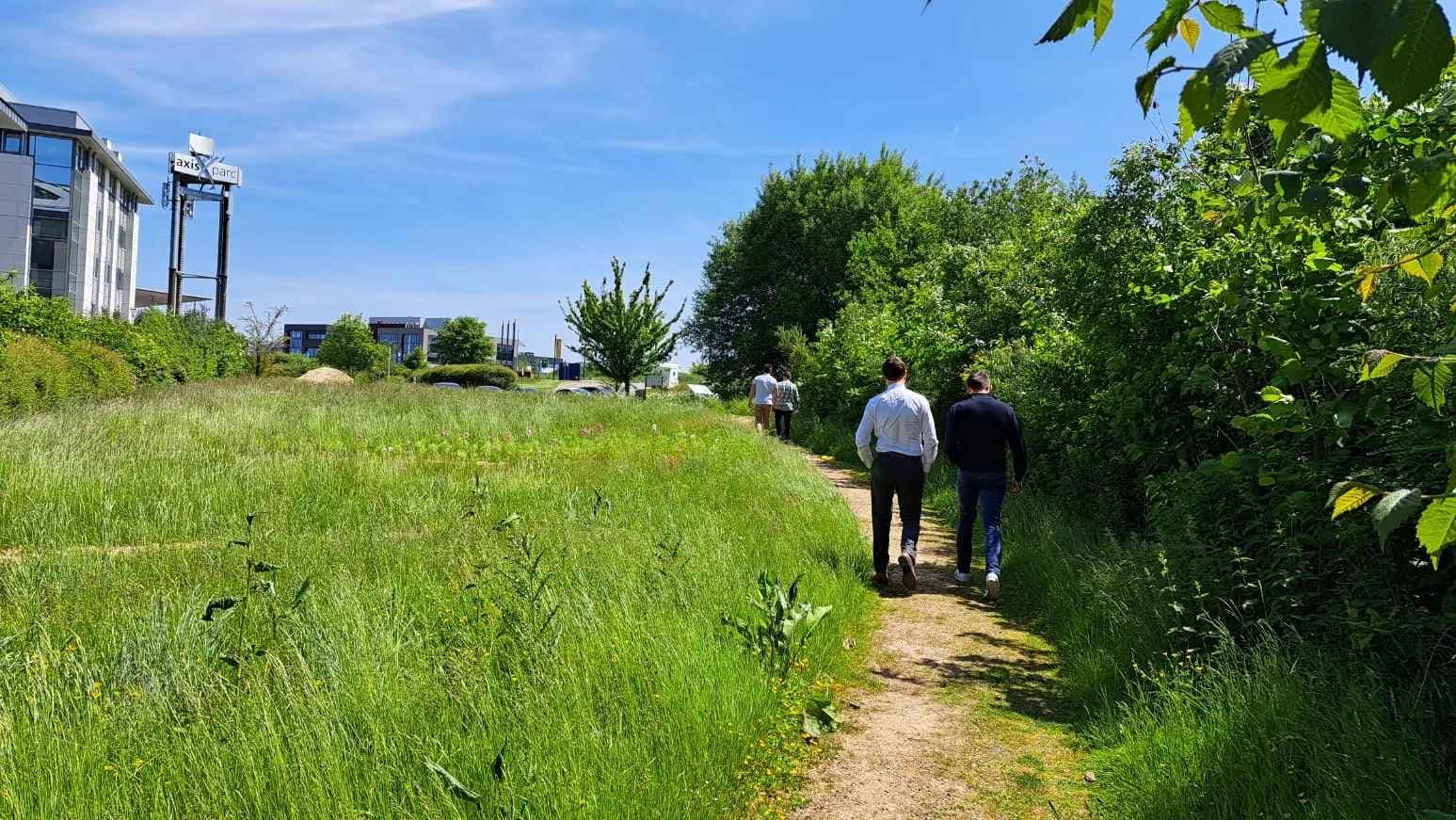
We see this constantly in our work with corporate clients across Belgium and the Netherlands. When we design an office forest for a campus setting, the most reliable signal that a project will succeed is the availability of even a small patch of underused ground, whether that's a neglected lawn strip, a paved border along a car park, or an empty courtyard corner. The Miyawaki method is specifically built for constrained urban plots, which is exactly what most corporate campuses have.
Our office forest design service is built around this method, and it's designed to work on the kinds of awkward, fragmented outdoor spaces that most facility managers have written off as unusable.
How small can a Miyawaki forest actually be?
A Miyawaki forest can work on plots as small as 30 to 50 square metres. That's roughly the footprint of a standard parking bay multiplied by five, which puts it well within reach for most corporate campuses.
The method's density is what makes small plots viable. You're planting 3 to 9 native saplings per square metre, using multiple layers: ground cover, shrubs, understory trees, and canopy trees. Each layer competes for light, which drives upward growth and creates structural complexity that a conventional ornamental planting never achieves on the same footprint.
For facility managers asking whether their space is "too small to do anything meaningful," the honest answer is: almost certainly not. A 100 square metre plot along a building facade, a triangular patch between two access roads, or a strip along a perimeter fence can all support a Miyawaki planting that reads as genuinely forest-like within two years.
The constraint that actually matters is soil quality, not surface area. Compacted, nutrient-poor ground typical of corporate campuses needs preparation: aeration, organic matter addition, and sometimes drainage work. That soil preparation phase is where most of the upfront cost sits, and skipping it is the most common reason Miyawaki plantings underperform.
What does a Miyawaki office garden cost, and how do you justify it?
Costs vary by site condition, plot size, and species mix, but a realistic range for a prepared and planted Miyawaki office garden in Belgium runs from roughly €80 to €150 per square metre for the initial installation, including soil preparation, native saplings, and a one-to-two-year aftercare period. A 100 square metre plot therefore sits in the €8,000 to €15,000 range as a complete project.
That number is hard to justify in isolation. The business case gets traction when you frame it against the right comparators:
- Conventional landscaping with ornamental shrubs and seasonal bedding plants carries ongoing maintenance costs of €15 to €25 per square metre per year. A Miyawaki forest, once established after roughly three years, becomes largely self-sustaining and requires minimal intervention.
- Employee wellbeing infrastructure like outdoor furniture, pergolas, or paved terrace areas costs a comparable amount but delivers no biodiversity value and contributes nothing to ESG reporting.
- ESG and sustainability reporting increasingly requires demonstrable environmental action, not just policy commitments. A planted, measurable green space with documented biodiversity counts as a physical outcome, not a pledge.
When we scope projects with finance teams, we find the strongest argument is the maintenance trajectory. Year one is the most expensive; by year four, you're spending a fraction of what a conventional planted border costs annually. Pair that with the employee attraction and retention narrative that HR already owns, and the business case becomes a joint submission rather than a facilities budget line.
What are the real drawbacks of the Miyawaki method on office sites?
The Miyawaki method has genuine limitations that are worth naming honestly rather than glossing over.
Soil preparation is non-negotiable and adds cost. Corporate campuses often have heavily compacted ground from construction activity or decades of vehicle use. Without proper preparation, the dense planting simply won't establish. This is the step that separates a Miyawaki forest that thrives from one that stagnates.
The first two years look rough. Dense planting with native saplings at early growth stages doesn't look like much. Weeding is intensive during this period because the canopy hasn't closed yet. Facility managers need to set expectations with HR and leadership that the visual payoff comes in year two or three, not at planting day.
Species selection requires local expertise. The method only works with native species matched to your soil type and regional climate. Substituting non-native ornamentals because they look better at the garden centre undermines the entire ecological logic. This is where working with a specialist rather than a general grounds contractor makes a concrete difference.
It's not suitable for every site configuration. Narrow strips under two metres wide, heavily shaded north-facing plots, or areas with underground utilities at shallow depth all create complications. A proper site assessment before committing to a design is essential.
Our nature restoration approach includes that site assessment as a standard first step, specifically to catch these constraints before they become problems mid-project.
How does an office Miyawaki garden connect to ESG and sustainability reporting?
In 2026, sustainability reporting frameworks are tightening. The EU's Corporate Sustainability Reporting Directive (CSRD) requires large companies to disclose environmental impacts with increasing specificity, including biodiversity-related risks and actions. A Miyawaki office garden isn't just a nice amenity; it's a documentable intervention with measurable outcomes.
Biodiversity indicators are countable. Species richness before and after planting, insect and bird activity, canopy cover percentage. These are metrics that go directly into environmental reporting. A conventional ornamental border gives you none of that.
Carbon sequestration is a secondary benefit. A dense native planting sequesters carbon from day one, and that accumulation is trackable over the project lifetime. For companies working toward net-zero commitments or looking to complement a forest offset program, an on-site planting adds a visible, tangible dimension to what can otherwise feel like an abstract accounting exercise.
The communication value is real too. Employees walking past a forest they can see growing, with a sign explaining what was planted and why, connects sustainability commitments to daily experience in a way that a PDF report never does. HR teams consistently tell us this kind of visible action lands better internally than any policy document.
Who manages the green space after it's planted?
After the initial two-to-three-year establishment period, a Miyawaki forest is genuinely low-maintenance. The closed canopy suppresses weeds, the layered ecosystem becomes self-regulating, and the primary task shifts to occasional monitoring rather than active management.
During establishment, the work is more intensive: watering in dry periods, selective weeding, and replacing any saplings that don't take. This is typically handled by the planting contractor as part of an aftercare agreement, which avoids adding specialist knowledge requirements to your internal facilities team.
The practical question for most facility managers is whether to fold aftercare into an existing grounds contract or keep it with a specialist for the establishment period. Our recommendation, based on what we've seen work, is to keep specialist oversight for the first two years and then transition to your existing contractor with a clear handover protocol. That way the critical establishment phase is managed by people who understand Miyawaki dynamics, and you're not creating permanent vendor dependency.
For companies already exploring the full range of what their outdoor spaces can do, our complete service overview covers everything from forest planting to rooftop farms and sustainability consulting.
A Miyawaki-style office garden is the most ecologically efficient way to transform dead corporate outdoor space into something that delivers for employees, ESG reporting, and biodiversity simultaneously. Book a site assessment with Forest Forward and we'll tell you exactly what your plot can support and what it will take to get there.
Frequently asked questions
What is the Miyawaki method and why does it work for office gardens?
The Miyawaki method is a dense native-species planting technique developed by botanist Akira Miyawaki. It works by planting multiple native tree species very close together, triggering natural competition that accelerates vertical growth. For office gardens, it's effective because it delivers visible forest density within two to three years on small plots, requires minimal maintenance once established, and generates measurable biodiversity outcomes that support ESG reporting.
Can you plant a Miyawaki forest anywhere on a corporate campus?
Not everywhere, but on more plots than most facility managers assume. The method works on plots as small as 30 to 50 square metres. The real constraint is soil condition, not surface area. Heavily compacted ground, shallow underground utilities, or very narrow strips under two metres wide create complications. A site assessment identifies these issues before they affect the project. Neglected lawns, car park borders, and courtyard corners are typically well-suited.
What are the main drawbacks of the Miyawaki method?
The three most significant drawbacks are soil preparation cost, a visually unimpressive first two years while the canopy closes, and the need for accurate native species selection matched to local soil and climate conditions. Skipping soil preparation is the most common reason Miyawaki plantings underperform. Managing internal expectations about the visual timeline is equally important, since the payoff is real but delayed by one to two growing seasons.
How much does a Miyawaki office garden cost?
In Belgium, a complete Miyawaki office garden installation including soil preparation, native saplings, and a two-year aftercare period typically runs from €80 to €150 per square metre. A 100 square metre project therefore costs roughly €8,000 to €15,000. The key financial argument is the maintenance trajectory: conventional ornamental planting costs €15 to €25 per square metre per year in ongoing maintenance, while a Miyawaki forest becomes largely self-sustaining after three years.
Does a Miyawaki forest count toward ESG or sustainability reporting?
Yes, in concrete and documentable ways. Biodiversity indicators such as species richness, insect activity, and canopy cover are measurable before and after planting and can be reported directly. Carbon sequestration accumulates from the first growing season. Under the EU's Corporate Sustainability Reporting Directive (CSRD), companies are required to disclose biodiversity-related actions with increasing specificity, and a planted, monitored native forest qualifies as a physical environmental intervention.
Who maintains a Miyawaki office garden after it's planted?
During the first two to three years, aftercare is typically managed by the planting contractor under a dedicated agreement covering watering, weeding, and sapling replacement. After establishment, the closed canopy becomes largely self-regulating and maintenance requirements drop significantly. The practical approach is to keep specialist oversight for the establishment period, then transition to an existing grounds contractor with a clear handover protocol, avoiding permanent specialist dependency while protecting the critical early phase.
Sources
- European Commission, 2022 — Corporate Sustainability Reporting Directive (CSRD), Directive 2022/2464/EU, establishing mandatory sustainability disclosure requirements for large companies in the EU.
Share this post
Forest Forward Team
Stay up to date with our latest insights
Related articles
Real CSR activities for companies beyond team events
CSR activities are the concrete initiatives a company runs to create social, ecological or ethical impact beyond its core business, from volunteering and local community projects to nature restoration, sustainable sourcing and education. A fun day at a go-kart track is not one of them.

Sustainable business examples: 5 real cases from Belgian companies
Looking for proof that sustainability works beyond a slide deck? Here are 5 Belgian companies making it visible, measurable and real.
Sustainable business practices: a practical guide for 2026
Sustainable business means running your company with people, planet and profit weighed together, not profit alone. Here's how to actually do it.