
School forests and curriculum goals: how they connect

Forest Forward Team
04-05-2026
•Why school forests are a curriculum tool, not just a landscape feature
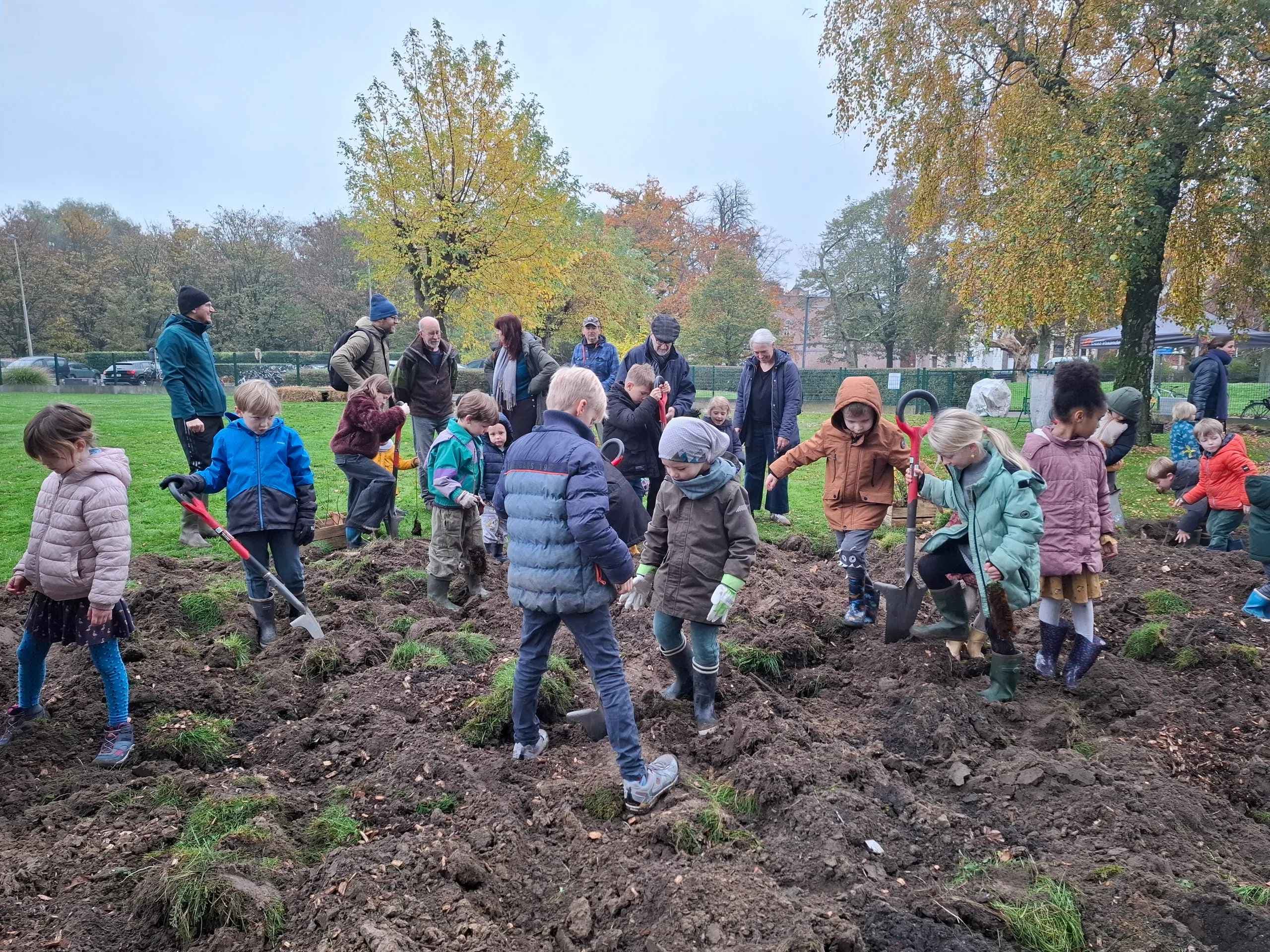
A school forest is a structured learning environment that delivers against measurable educational goals. When we work with schools through our school forest programme, the question principals ask most often is not "will students enjoy it?" They already know the answer. The real question is: "How do I justify this to my school board?" The answer is straightforward: a well-designed school forest aligns with Flemish policy priorities, minimum attainment targets, and cross-curricular development goals in ways that a whiteboard and a textbook simply cannot replicate.
We see this consistently in our work with primary and secondary schools across Belgium. The schools that get the most out of a forest space are the ones that treat it as a teaching asset from day one, not an afterthought. That means connecting it to what teachers are already required to deliver, not adding it on top of an already full timetable.
How does Flemish education policy support school greening?
The Flemish government's education policy explicitly prioritises greening school buildings and grounds. The Beleidsnota Onderwijs en Vorming 2024-2029, published by the Flemish Parliament, identifies the greening of school environments as a direct lever for improving educational quality, air quality, and the physical conditions for learning. This is not aspirational language buried in an appendix. It is a stated priority for the current policy cycle.
The Vlaamse Onderwijsraad (VLOR) reinforces this with a clear recommendation for environmental interventions in schools, including green schoolyards and kitchen gardens, as practical tools for embedding sustainable behaviour. Their framework positions these interventions under the "environment" strand of sustainability education, where schools choose their own priorities for greater ownership and impact. A school forest fits this framework precisely because it is a physical, permanent intervention that students interact with daily.
The policy direction is clear. Schools that invest in a forest space are moving with it, not against it.
Which curriculum goals does a school forest actually cover?
A school forest connects to multiple mandatory attainment domains at once, across both primary and secondary levels. The most direct overlap is with science and technology. From September 2025, new minimum attainment targets for sciences and technology are being phased in across Flemish primary education. These targets require students to demonstrate individual mastery of concepts including ecosystems, biodiversity, and sustainable resource management. A forest planted on school grounds gives students a living, changing ecosystem to observe across seasons, not a diagram in a workbook.
Beyond sciences, the connections run wide:
- STEM and fieldwork skills. Students can measure tree growth, track insect populations, document seasonal change, and build basic ecological data sets. This is the kind of hands-on inquiry that STEM education frameworks call for but rarely get a physical space to happen in.
- Wellbeing and inclusion. VLOR's guidance on learners with specific needs highlights the value of motivating outdoor environments for engagement and self-regulation. A forest space gives students who struggle with traditional classroom settings a genuinely different context for learning.
- Language and communication. Observation journals, field reports, and presentations about what students find in the forest build written and spoken language skills in an authentic context.
- Citizenship and sustainability. The Flemish Duurzaam Educatiepunt recommends hands-on nature contact as a core method for the "mens en wereld" domain, with biodiversity as a central theme. A school forest is not a supplement to this. It is the method.
The development goals in Flemish special education (BuBao) also explicitly name ecological literacy and nature sciences as targets, making a school forest relevant across mainstream and specialist settings alike.
What is the Miyawaki method and why does it work for schools?
The Miyawaki method creates a dense, multi-layered native forest in a small footprint, and it establishes faster than conventional planting. Developed by Japanese botanist Akira Miyawaki, the approach uses native tree and shrub species planted close together, which encourages rapid canopy development and high biodiversity from the start.
For schools, this matters for two practical reasons. First, a small outdoor space, even a strip of unused ground alongside a sports court, is enough. Second, students see results within a single school year. Watching a planted sapling develop into a recognisable young forest during a student's time at school is a fundamentally different experience from being told that "trees take decades to grow."
Our nature restoration approach applies exactly this kind of thinking to underused green space, transforming ecologically thin areas into biodiverse habitats that deliver measurable outcomes. The same principles that make this work for corporate campuses apply directly to school grounds.
How do schools fund a school forest without draining their own budget?
Corporate sponsorship is the most reliable funding route, and it works because companies need what a school forest provides. Belgian companies with deforestation obligations under Flemish law need to compensate for trees cleared during construction or development. Others are pursuing voluntary sustainability commitments and looking for tangible, visible projects that go beyond carbon credit certificates. A school forest gives a corporate sponsor a named, physical asset, a story they can tell employees and stakeholders, and a direct connection to the next generation of environmental citizens.
Eneco's partnership with ten Flemish schools in Mechelen is a concrete example of this model working in practice. Eneco donated a school forest to each participating school, bridging corporate sustainability goals and educational need in a single project. This is the template: a company with a green commitment, a school with unused outdoor space, and a shared interest in making something real happen.
When we help schools approach potential corporate partners, the pitch is not "please donate to our garden." It is "here is a project that delivers against your ESG reporting requirements, gives your employees a team-building activity, and creates a lasting biodiversity asset with your name on it." That is a different conversation, and it lands differently. You can explore the full range of ways we structure these partnerships on our services overview.
For schools interested in how corporate forest investment works more broadly, our article on how corporate forests boost biodiversity on company land explains the mechanics and the business case that makes sponsors say yes.
What happens after the forest is planted?
Maintenance is the question every principal asks, and it is the right question. A school forest planted with native species using the Miyawaki method is designed to become self-sustaining over time. The dense planting structure means the canopy closes quickly, shading out invasive weeds and reducing the need for ongoing intervention. In the early years, some light maintenance is needed, but this is structured as part of the educational programme, not handed to an already-stretched caretaking team.
Our biodiversity transformation service includes ongoing guidance so that schools are not left to figure out aftercare alone. We design every project so that the maintenance burden decreases as the forest matures, and so that the activities required in the early years — watering, mulching, monitoring — are things students can do as part of their curriculum work.
The forest does not need a dedicated groundskeeper. It needs engaged students and a teacher who knows how to use it.
A school forest is not a luxury add-on for well-funded schools. It is a curriculum-aligned, policy-supported, fundable teaching environment that happens to also transform how your school grounds look and feel. Knowing this changes the conversation you have with your school board, your science teachers, and your potential corporate sponsors. To take the next step, get in touch with our team to discuss what a school forest project could look like for your specific site and budget.
Frequently asked questions
Do school forests follow the national curriculum?
School forests in Flanders align with the Flemish minimum attainment targets rather than a single national curriculum. They connect most directly to science and technology goals, including ecosystems, biodiversity, and sustainable resource management, but also support STEM fieldwork, language development, and citizenship education. From September 2025, new minimum targets for sciences in primary education make outdoor learning environments like school forests even more relevant to what schools are legally required to deliver.
What is the Miyawaki method for schools?
The Miyawaki method is a dense-planting technique that uses native tree and shrub species planted close together to create a multi-layered forest in a small footprint. For schools, it means a meaningful forest can grow in a space as small as a few dozen square metres. The forest establishes quickly enough that students see visible growth within a single school year, making it a genuinely engaging teaching tool rather than a long-term promise.
How can a school fund a forest without its own budget?
The most effective route is corporate sponsorship. Companies with Flemish deforestation compensation obligations or voluntary ESG commitments are actively looking for tangible green projects. A school forest offers a named, visible asset, team-building potential, and a direct link to environmental education. Schools approach companies not as charity cases but as partners in a project that delivers against the company's own sustainability reporting needs.
How much outdoor space does a school need for a forest?
A Miyawaki-method forest can be established in a surprisingly small area, sometimes as little as a few dozen square metres. The dense planting creates genuine biodiversity even at small scale. Schools with unused strips of ground alongside sports courts, fences, or buildings often have more than enough space. The key is soil quality and species selection, not total area.
Who maintains the school forest after it is planted?
In the early years, light maintenance is needed, but it is designed to be done by students as part of curriculum activities, not by additional staff. Watering, mulching, and seasonal monitoring are all curriculum-compatible tasks. As the canopy closes, the forest becomes increasingly self-sustaining. Forest Forward provides aftercare guidance so schools are not managing this alone, and the maintenance burden decreases as the forest matures.
How does a school forest support students with specific educational needs?
Outdoor learning environments give students who find traditional classroom settings difficult a different context for engagement and self-regulation. VLOR's guidance on learners with specific needs highlights the value of motivating, varied environments. A forest space supports sensory exploration, hands-on investigation, and collaborative activity in ways that are genuinely inclusive, not just theoretically so.
Sources
- Vlaams Parlement, 2024 — Beleidsnota Onderwijs en Vorming 2024-2029, identifying school greening as a priority for educational quality
- Vlaanderen.be, 2025 — Overview of new minimum attainment targets for sciences and technology in Flemish primary education from September 2025
Share this post
Forest Forward Team
Stay up to date with our latest insights
Related articles
Real CSR activities for companies beyond team events
CSR activities are the concrete initiatives a company runs to create social, ecological or ethical impact beyond its core business, from volunteering and local community projects to nature restoration, sustainable sourcing and education. A fun day at a go-kart track is not one of them.

Sustainable business examples: 5 real cases from Belgian companies
Looking for proof that sustainability works beyond a slide deck? Here are 5 Belgian companies making it visible, measurable and real.
Sustainable business practices: a practical guide for 2026
Sustainable business means running your company with people, planet and profit weighed together, not profit alone. Here's how to actually do it.