Sustainable team building that actually creates impact

Forest Forward Team
15-06-2026
•Why most sustainable team activities leave no trace
We see this constantly in our work with HR and People & Culture managers: the brief starts with genuine ambition, connect the team, demonstrate sustainability values, create something meaningful, and ends with a half-day activity that nobody can describe three months later. The problem is not the intention. The problem is that the activity was designed as an experience, not as a project.
A beach clean-up is satisfying in the moment. A workshop on circular thinking is interesting. But neither leaves anything behind. No site you can revisit. No biodiversity gain you can measure. No story that holds up when a new employee asks what your company actually does for the environment.
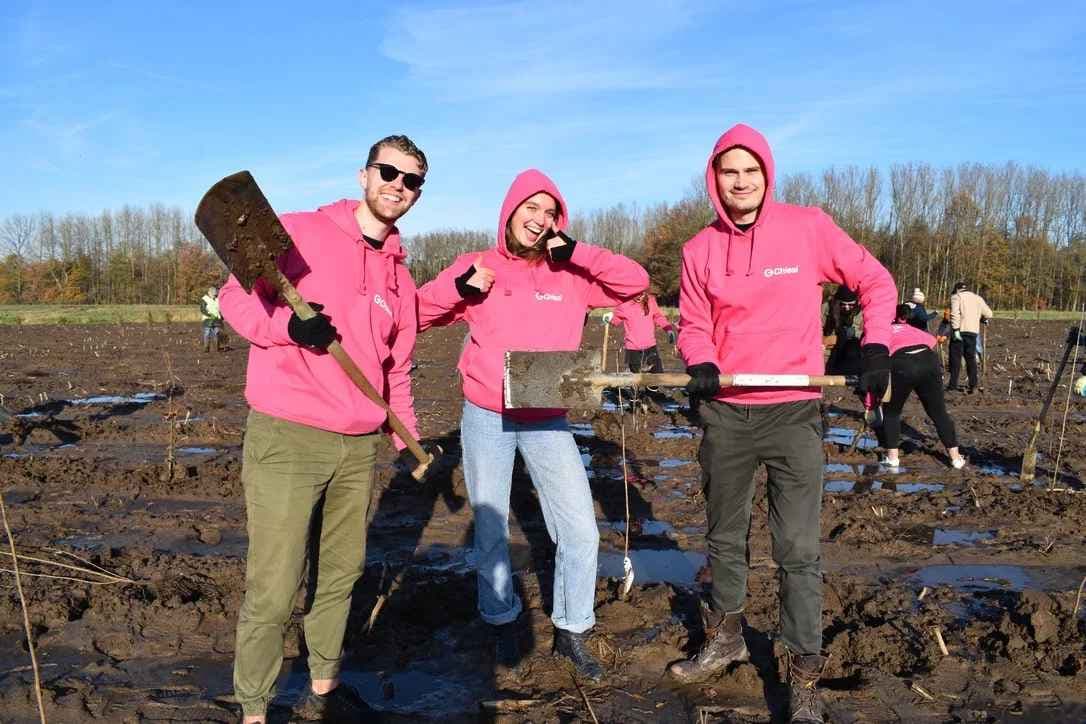
The shift that changes everything is moving from "activity" to "project." When your team spends a day planting a corporate forest near your offices, they are not just bonding over a shared task. They are building something that will still be there in ten years, that grows visibly, that you can photograph every spring, and that you can point to in your sustainability report with a real number attached to it.
That is the difference between a symbolic gesture and genuine team engagement your people are proud to own.
What makes a team activity genuinely sustainable?
Genuine sustainability in a team context means the output outlasts the day. Three conditions need to be met.
First, there has to be a concrete ecological goal. Not "we care about nature" but "we are restoring this specific 2,000 square metre plot of degraded land near our facility" or "we are planting 300 native trees on this identified site." The goal must be specific enough to be measured and reported.
Second, the project needs local anchoring. When employees can drive past the site on their way to work, when they can bring their children to visit in summer, when the location is genuinely connected to their daily geography, the project becomes part of their identity. Remote or abstract projects, offsetting carbon somewhere far away, donating to a global fund, do not produce the same ownership. Local projects do.
Third, the impact has to be trackable. How many trees survived the first winter? How many species have been recorded on the restored site? How many tonnes of CO₂ will the forest sequester over its lifetime? These are not just CSR metrics. They are the foundation of a story you can tell credibly to clients, candidates, and the press.
How to structure a team day that builds something lasting
The format that works, in our experience building these projects for Belgian companies, is straightforward: combine a physical, participatory activity with expert guidance, and connect it to a project that continues after the day ends.
Before the day, align HR, the sustainability team, and communications around one shared goal. What is the ecological objective? What does success look like in twelve months? What will you communicate, and to whom? This conversation takes an hour and prevents the activity from becoming a one-off.
During the day, the team works on-site with guidance from ecologists or nature managers who explain what they are doing and why. Planting a Miyawaki-style native forest, restoring a degraded green zone, building habitat features. These are physical, collaborative tasks that require everyone to contribute. The work is visible and tangible. Teams consistently report that working together on something real, with their hands, creates stronger cohesion than any indoor exercise. You can read more about what that looks like in practice in our piece on the benefits of an office food forest for your team.
After the day, document the result: a count of trees planted, a before-and-after of the site, a short video of the team in action. Schedule a follow-up visit six months later. That follow-up is what converts a one-off activity into a living project your team stays connected to.
What HR, CSR, and communications each get from this
The reason this format works for Belgian companies is that it solves three separate problems at once, without asking any of the three teams to compromise.
For HR and People & Culture, the value is team cohesion built around shared pride. Working physically together on a meaningful project creates a kind of memory that a dinner or escape room simply does not. Employees talk about it differently. They show the photos to friends. They feel ownership of something that exists in the world. That is powerful for retention and for attracting candidates who want to work somewhere with genuine values.
For sustainability and CSR managers, the value is measurability. A corporate forest project delivers numbers you can put in your ESG report: area of land improved, number of native species planted, estimated CO₂ sequestration, confirmed biodiversity outcomes. These are not estimates or proxies. They are physical results on a specific piece of land.
For marketing and communications, the value is a story with visual depth. Before-and-after images of a restored site. A team of sixty colleagues planting trees in autumn light. A forest that carries your company's name and grows every year. This is employer branding content that does not look like employer branding content. It looks like proof.
The most common mistakes companies make
Choosing the activity before the goal. If you start by browsing "sustainable team building ideas" and pick the one that sounds fun, you will end up with a nice day and no lasting impact. Start with the ecological objective and work backwards to the activity.
Treating it as a one-off. A single planting day is a good start, but it is not a project. The companies whose teams stay engaged are the ones who return to the site, track the progress, and share updates internally. The forest becomes a chapter in the company's story, not a footnote in the events calendar.
Under-communicating the result. We see this often: a company does genuinely good work, plants a real forest, and then posts one photo on LinkedIn and moves on. The impact deserves more. A documented result, species count, area, CO₂ projection, site coordinates, is the difference between a claim and evidence. It is also what makes the story credible to external audiences who are increasingly sceptical of green gestures.
Keeping it too abstract. If the team does not understand what they are planting, why those species, why that location, and what will happen to the site in five years, the activity loses half its value. Expert guidance on the day is not a luxury. It is what converts physical effort into genuine understanding and long-term commitment. Our article on forest compensation in Flanders illustrates what happens when ecological projects lack that grounding.
Where to start if you want to do this properly
The simplest entry point is a company forest near your offices or facilities. Forest Forward designs these projects from site selection through planting and long-term management, and we build the team experience into the process. Your team plants the forest. We make sure it survives, grows, and delivers the biodiversity outcomes you can report on.
For companies that want to start smaller or test the format before committing to a full forest, Start2Forest lets you join a collective planting project from as few as five trees, with certificates and documentation included.
If your site has underused or degraded green space that could become something ecologically valuable, our nature restoration service turns that space into a biodiverse habitat, another strong format for a meaningful team day with lasting results.
The core insight is simple: the difference between a team day people remember and one they forget is whether it produces something that still exists next year. You now know how to structure a sustainable team activity so that it delivers real biodiversity impact, measurable ESG outcomes, and the kind of team pride that lasts. Request a conversation with Forest Forward about building your company forest and get a concrete proposal for a project your team can plant, own, and come back to.
Frequently asked questions
What is the difference between sustainable team building and a regular team outing?
A regular team outing focuses on shared experience and enjoyment. Sustainable team building adds a concrete ecological or social output to that experience. The key distinction is whether something lasting is produced. Planting a native forest, restoring a degraded green zone, or improving a local habitat creates a physical result that persists after the day ends. That result can be measured, reported, and revisited, which is what separates a meaningful project from a pleasant memory.
How do you measure the impact of a sustainable team building activity?
Measurable outcomes depend on the type of project. A tree-planting day produces a species count, an area figure in square metres, and a projected CO₂ sequestration estimate over the forest's lifetime. A nature restoration project generates before-and-after ecological assessments and biodiversity indicators. The key is to document the result immediately after the activity and track it at intervals, so you have data that holds up in ESG reports and internal communications rather than a general claim about caring for nature.
How many employees can participate in a corporate forest planting day?
Forest planting projects scale well across team sizes. A small team of ten can plant a meaningful patch of native woodland in a single morning. Groups of fifty to several hundred employees can work across a larger site in organised teams, each responsible for a section. The physical nature of the work means everyone contributes directly, regardless of team size. The format works for a department day, a company-wide event, or a leadership offsite with a smaller group.
What makes a local nature project better than a carbon offset programme?
Local projects create visibility, ownership, and connection that remote offset programmes cannot replicate. When your team plants a forest near your offices, employees can visit the site, watch it grow, and point to it as something they built. That is qualitatively different from purchasing carbon credits linked to a forest in another country. Local projects also tend to deliver co-benefits, biodiversity, water management, urban cooling. That offset programmes do not. Both can have a role in a sustainability strategy, but for team engagement and communicable impact, local wins.
How do you avoid greenwashing when communicating a sustainable team activity?
Greenwashing risk drops sharply when you lead with specifics rather than sentiment. State the number of trees planted, the species used, the area of land improved, and the organisation that managed the project. Include before-and-after documentation. Commit to follow-up reporting at six and twelve months. Avoid language like "we are committed to a greener future" without evidence. The credibility of your communication is directly proportional to the specificity of the result you can show. A real project with real numbers is its own best defence against greenwashing accusations.
Can a sustainable team building project count toward our ESG reporting?
Yes, provided the project generates documented, verifiable outcomes. Native tree planting contributes to biodiversity and carbon sequestration metrics. Nature restoration improves land-use quality indicators. Both can be referenced in sustainability reports aligned with frameworks such as the EU's Corporate Sustainability Reporting Directive, which requires companies above certain thresholds to report on environmental impacts and nature-related risks. Working with a partner who documents outcomes formally, species planted, area improved, ecological assessments, gives you the evidence base you need for credible ESG disclosure.
Sources
- European Commission, 2022 — Corporate Sustainability Reporting Directive (CSRD), Directive 2022/2464/EU — EU directive requiring large and listed companies to report on environmental and social impacts, including nature-related risks and biodiversity.
Share this post
Forest Forward Team
Stay up to date with our latest insights
Related articles

Real CSR activities for companies beyond team events
CSR activities are the concrete initiatives a company runs to create social, ecological or ethical impact beyond its core business, from volunteering and local community projects to nature restoration, sustainable sourcing and education. A fun day at a go-kart track is not one of them.
Sustainable business examples: 5 real cases from Belgian companies
Looking for proof that sustainability works beyond a slide deck? Here are 5 Belgian companies making it visible, measurable and real.
Sustainable business practices: a practical guide for 2026
Sustainable business means running your company with people, planet and profit weighed together, not profit alone. Here's how to actually do it.