Teambuilding in nature: how to plant a day that stays visible

Forest Forward Team
30-06-2026
•We see this constantly in our work with HR and People & Culture managers at mid-sized Belgian companies: the team event goes well, people enjoy themselves, and then it disappears. Photos get posted on LinkedIn, someone writes a thank-you email, and by the following Monday it's already background noise. The bowling afternoon, the escape room, the cooking class, fun, yes. Lasting, no.
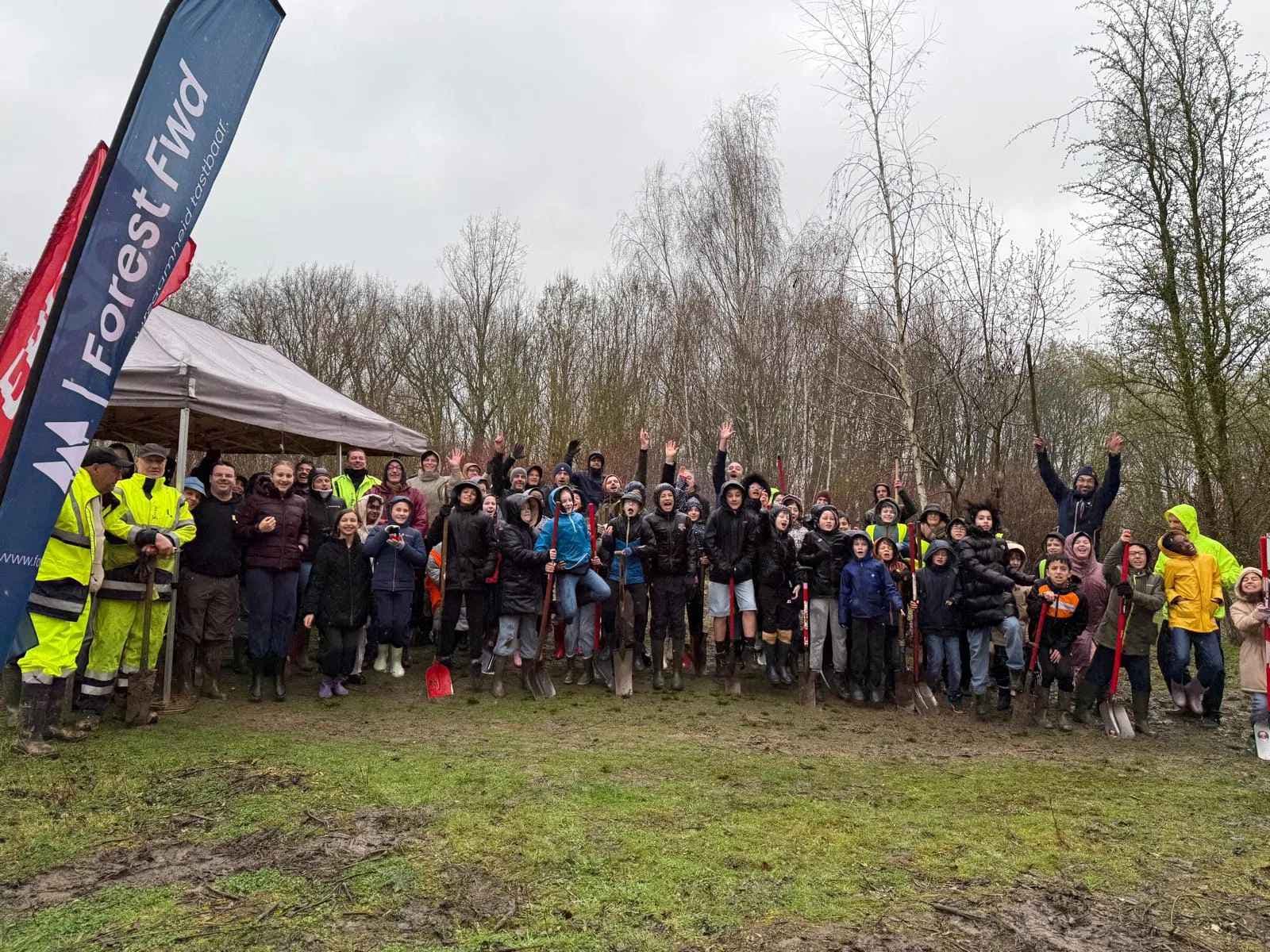
What we've found, across dozens of corporate forest and nature restoration projects, is that one variable separates a team day people forget from one they keep talking about: did the team make something that's still there? A row of native trees on a hillside. A section of restored meadow. A food forest that will feed a neighbourhood for decades. That physical, visible result changes how the experience lands, and how long it stays.
If you're an HR manager looking for a team activity that doubles as a genuine sustainability story, this article is your practical guide to making it happen.
Why nature teambuilding hits differently than a fun afternoon
A team activity in nature works better than a standard fun outing not because it's more virtuous, but because it's more memorable. When people work together on something physical and local, they form a shared reference point that outlasts the day itself.
The psychology here is straightforward. Shared effort on a meaningful task builds stronger bonds than shared entertainment. When your team plants 50 trees together, they've navigated logistics, made decisions, gotten their hands dirty, and produced something real. That's a fundamentally different experience from cheering each other on at a bowling alley. The result is visible, it has a GPS coordinate, and it will still be there in five years.
There's also a communication dividend. A team day that ends with a measurable outcome, trees planted, square metres of habitat restored, invasive species removed, gives you something to share internally and externally. Not just a group photo, but a number. A before-and-after. A story with a second chapter, when you go back six months later to see how the forest is growing.
What you can actually do in one day
One day is enough to create something lasting, as long as the activity is well-designed. Here are the formats that work in a Belgian context, depending on your team size and the time of year.
Tree planting in a corporate forest. The most direct option. Your team plants native trees on a site near your offices, guided by our ecologists. Groups from 10 to several hundred people can participate meaningfully. The trees stay, the site is mapped, and your company's contribution is documented. Our collective corporate forest programme allows companies to join an existing project if you don't yet have a dedicated site.
Office forest creation using the Miyawaki method. If your company has underused outdoor space, even a plot of 100 m² can become a dense, biodiverse forest within three years. Your team plants together on your own grounds, which means the result is literally on your doorstep, visible every single day. Our office forest service covers design, species selection, and the planting event itself.
Nature restoration on an existing green zone. Some of the most powerful team days involve restoring something that's been neglected: removing invasive species, reinforcing native vegetation, improving access to a local nature area. Our habitat restoration work follows this exact model, turning degraded green zones into ecologically valuable spaces, with your team as the engine.
Food forest planting. A food forest combines biodiversity with a tangible, edible result. Teams plant fruit trees, berry shrubs, and perennial vegetables in a layered system that produces food for years. If you want to understand what this involves before committing, our article on planting a food forest the right way covers the methodology in detail.
The right format depends on three things: your team size, whether you have outdoor space at your location, and the season. We work with you on that choice from the start.
How to organise the day without the logistical headache
The biggest reason HR managers hesitate is the operational complexity. Who arranges the tools? Who guides the team? What if it rains? What's the plan for 80 people who've never planted a tree?
Our answer is simple: you don't carry any of that. A well-run nature team day is turn-key. We handle site selection or preparation, species planning, tools and materials, expert guidance on the day, safety, and the documentation of results. Your job is to show up with your team.
What makes the difference between a chaotic outdoor day and a genuinely cohesive experience is expert facilitation. When people understand why they're planting a specific species in a specific spot, when they can see the ecological logic of what they're doing, the activity becomes meaningful rather than just physical. We brief every team before they start and debrief at the end, what was planted, what it will become, and what your company's contribution means in measurable terms.
Seasonality matters too. Tree planting works best between October and March, when trees are dormant. Habitat restoration and food forest work can happen year-round. We advise on timing as part of the planning process.
How to make the impact visible long after the day
The day itself is the start, not the end. The companies that get the most out of a nature team event are the ones that build a follow-up rhythm.
Document the day with intention. Before-and-after photos, a count of trees planted, square metres restored, species introduced. These numbers are your internal and external communication material. They're specific, they're visual, and they're yours.
Give the result a name. Teams that name their forest, their plot, or their trees develop a relationship with the project. "Our forest" is a different sentence than "the trees we planted last November." That ownership sustains the conversation.
Go back. The most powerful moment in any corporate forest project is the return visit. Six months later, a year later, you walk the site with the team and see what grew. That second visit is where the investment in team cohesion compounds. We've seen teams who were sceptical on planting day become the loudest advocates for the project after seeing the growth.
Report on it. Your CSR or sustainability manager can include the project in annual reporting, with the tree count, biodiversity data, and carbon sequestration estimates we provide. That turns a team day into a measurable contribution to your ESG targets, not just a line item in the events budget.
A company forest near your offices creates exactly this kind of ongoing story: employees can visit, clients can be brought to the site, and the forest grows with the company.
The best team day isn't a fun activity. It's a living project your team can visit, photograph, and point to for years. Knowing this means you can stop choosing between team cohesion and sustainability impact, because a well-designed nature day delivers both at once. Your next step is to join Forest Forward's collective corporate forest programme, starting with as few as five trees, with a guided planting event included for larger contributions.
Frequently asked questions
What nature teambuilding activities work for large groups in Belgium?
Tree planting, habitat restoration, and food forest creation all scale well to groups of 50 to several hundred people. The key is structured facilitation: splitting large groups into smaller working teams, each with a clear task and an expert guide. Activities like removing invasive species, planting native trees, or restoring a meadow work in parallel across subgroups, keeping everyone active and contributing to a shared visible result.
How long does a nature team day typically take?
A well-structured nature team day runs between three and six hours, including briefing, the physical activity, and a closing moment where results are shared. Half-day formats work for smaller groups or focused planting activities. Full-day formats allow for more ambition: larger sites, more species, and a more relaxed pace that gives people time to connect. Travel time to and from the site is separate.
Can we organise a nature team day if we don't have outdoor space at our offices?
Yes. Companies without their own green space can join a collective forest project on an existing site, or work with a local landowner, municipality, or nature reserve. Forest Forward identifies suitable locations based on your region, team size, and the type of activity you want. The site doesn't need to be adjacent to your offices to create a strong sense of ownership.
What is the 20-5-3 rule for nature?
The 20-5-3 rule is a guideline for how much time in nature supports human wellbeing: 20 minutes outdoors three times a week for stress reduction, five hours per month in semi-wild nature for mood benefits, and three days per year in wilderness for deeper restoration. For employers, this is relevant context: a team day in a natural setting isn't just a nice gesture, it contributes to employee wellbeing in a way that a day in a conference room or activity centre simply doesn't.
How do we communicate the results of a nature team day internally and externally?
Start with specific numbers: trees planted, square metres restored, species introduced. Pair those with before-and-after photography taken on the day. Internally, share results in a team update and revisit them at the six-month mark. Externally, use the project in your sustainability reporting, on your website, and in employer branding content. A nature project with a documented result is a story with a second chapter, and that longevity is what distinguishes it from a standard team outing.
How far in advance do we need to plan a nature team event?
Four to eight weeks of lead time is realistic for most projects. That allows time to confirm the site, plan species selection based on the season, arrange tools and logistics, and brief participants in advance. For larger groups or more complex projects like a dedicated corporate forest, a longer runway of two to three months gives more flexibility on timing and location.
Share this post
Forest Forward Team
Stay up to date with our latest insights
Related articles
Real CSR activities for companies beyond team events
CSR activities are the concrete initiatives a company runs to create social, ecological or ethical impact beyond its core business, from volunteering and local community projects to nature restoration, sustainable sourcing and education. A fun day at a go-kart track is not one of them.
Sustainable business examples: 5 real cases from Belgian companies
Looking for proof that sustainability works beyond a slide deck? Here are 5 Belgian companies making it visible, measurable and real.
Sustainable business practices: a practical guide for 2026
Sustainable business means running your company with people, planet and profit weighed together, not profit alone. Here's how to actually do it.