Transform your outdoor office into a thriving green workspace

Forest Forward Team
20-05-2026
•We see this constantly in our work with sustainability managers at Belgian corporations: a neglected patch of ground behind the headquarters, an overgrown strip along the car park perimeter, a scrubby lawn that nobody uses. The space exists. The sustainability mandate exists. What's missing is the bridge between them. That bridge isn't a tree-planting certificate. It's a designed, ecologically functional green space that generates measurable biodiversity data, engages employees, and holds up under CSRD scrutiny.
Transforming underused outdoor space into a genuinely biodiverse workspace is more achievable than most sustainability teams assume. The decision framework isn't complicated. What matters is choosing the right intervention for your site, your reporting obligations, and your stakeholder audience.
Why outdoor greening is now an ESG reporting asset
Outdoor greening has moved from "nice to have" to a reportable ESG metric. Under the Corporate Sustainability Reporting Directive, companies above the CSRD threshold must disclose material impacts on biodiversity and ecosystems as part of their double materiality assessment. A restored green space on your own land generates the kind of primary, site-specific data that satisfies this requirement in a way that a carbon offset certificate never will.
Beyond compliance, the business case is solid. Employees who regularly work near or within natural environments show measurable improvements in concentration and stress reduction. The 15% productivity uplift cited across workplace wellbeing literature is consistent with what we observe in our own client projects after habitat restoration work. And for employer branding, a visibly green campus signals something to candidates and staff that a sustainability slide deck simply cannot.
What does "thriving green workspace" actually mean for a corporate site?
A thriving green workspace isn't a manicured lawn with a few planters. It's an outdoor environment that functions ecologically, not just aesthetically. That means native plant species that support pollinators, structural variety that creates habitat niches, and measurable indicators of biodiversity improvement over time.
For corporate sites, this translates into three distinct intervention types, each suited to different site conditions and ESG ambitions:
- Habitat restoration on neglected green areas: removing invasive exotic species, introducing native hedgerows, flower-rich meadows, and ecological buffer zones. This is the fastest route to measurable biodiversity net gain on land you already own.
- Dense micro-forest planting: using the Miyawaki method to establish a multi-layered native forest on a footprint as small as 50 square metres. High visual impact, high biodiversity value, and after the establishment phase, very low maintenance. Our article on Miyawaki-style office gardens covers exactly how this works on typical Belgian corporate campuses.
- Multifunctional green spaces: combining habitat creation with food production, employee recreation, and educational programming. Our office food forest approach shows how edible species and native biodiversity planting can share the same footprint productively.
The right choice depends on your available square metres, your maintenance capacity, and what your ESG report needs to demonstrate.
How habitat restoration delivers hard biodiversity metrics
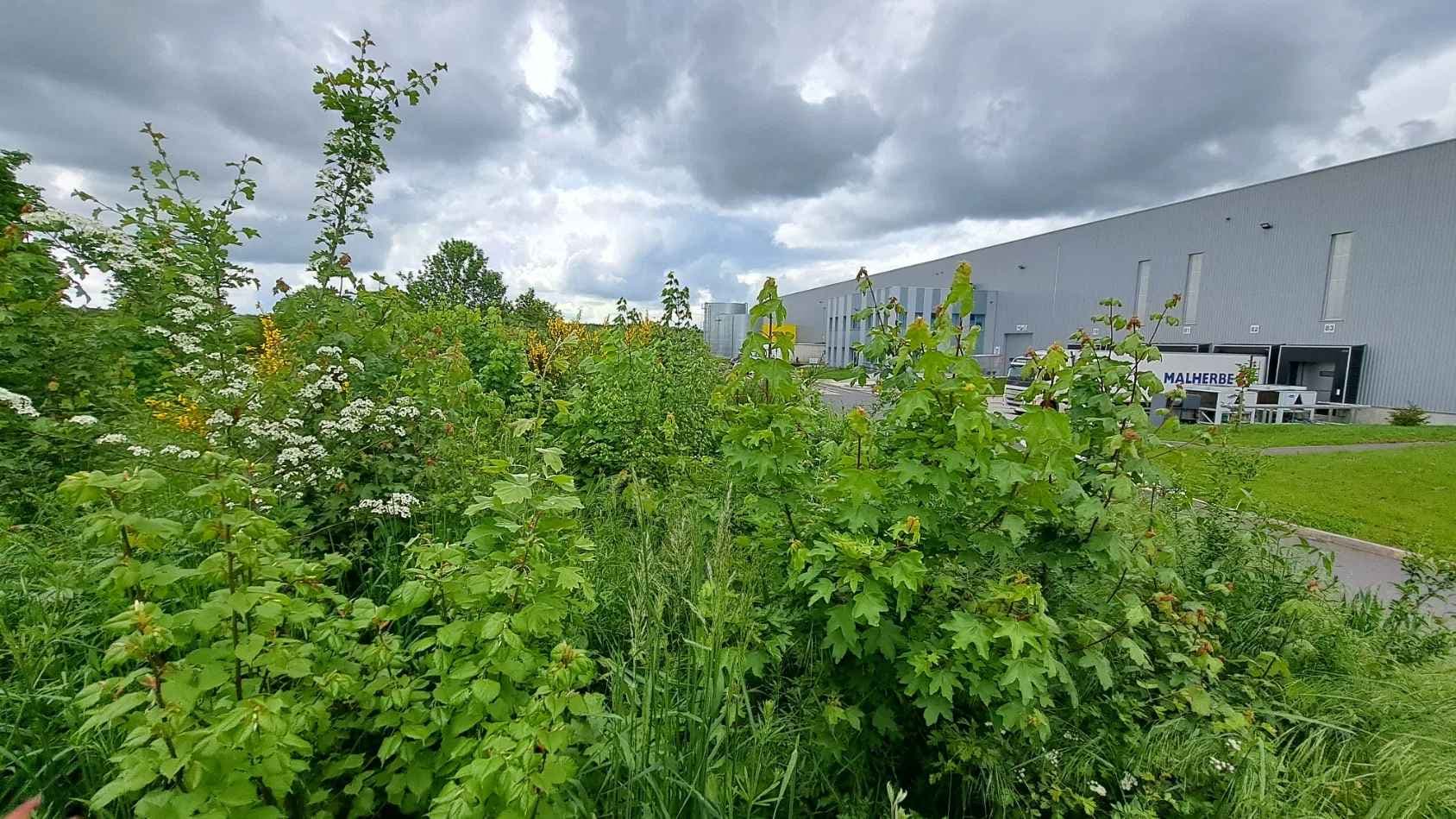
This is where our nature restoration service is most directly relevant. Habitat restoration on existing green space, rather than starting from scratch with new planting, delivers faster ecological results. Mature restored habitat provides more visible and ecologically functional outcomes than newly planted green spaces, because the soil structure, seed bank, and micro-habitat complexity are already partially present. You're unlocking latent ecological value rather than building from zero.
Concretely, what this looks like on a corporate site: we remove invasive species that are suppressing native vegetation, introduce structural elements like hedgerows and wildflower strips, create ecological connectivity between green zones, and establish a monitoring baseline. That baseline is what generates the biodiversity KPIs your ESG report can actually use. Species counts, habitat quality indices, pollinator activity — these are measurable and repeatable year-on-year.
Urban green corridors created this way act as stepping stones for wildlife, significantly increasing bird, insect, and mammal diversity in ways that a strip of ornamental grass never will. For companies doing a double materiality assessment that flags biodiversity as material, this is the kind of on-the-ground evidence that closes the gap between commitment and proof.
The social return is also real. Nature restoration doubles as team-building and employer branding. We regularly structure the initial habitat work as a guided employee activity, which builds internal ownership of the project and creates the kind of authentic storytelling that resonates in sustainability communications.
What stops most sustainability managers from acting on this
The objections we hear most often are predictable, and they're worth addressing directly.
"We already have a tree planting partnership." Tree planting certificates and a restored habitat on your own land serve entirely different functions. One is an offset. The other is a verifiable, site-specific biodiversity asset that you own, can measure, and can show to investors and employees. They're not substitutes.
"How do we prove the biodiversity impact for CSRD?" The answer is baseline monitoring and annual re-measurement. A properly designed habitat project establishes measurable KPIs at the outset and tracks them over time. This is exactly what CSRD's ESRS E4 biodiversity and ecosystems standard requires: disclosure of impacts on biodiversity, with metrics tied to specific sites and activities.
"The budget sits between sustainability and facilities and nobody owns it." This is the most common internal blocker we encounter. The resolution is framing the project correctly: this is not a landscaping cost, it's a sustainability investment with a reportable return. Our sustainability advisory service helps sustainability managers build exactly this internal business case, including KPI definition, stakeholder framing, and alignment with CSRD reporting requirements.
"We're worried about greenwashing." Greenwashing risk comes from overclaiming vague commitments. A physically restored habitat with documented species monitoring and annual reporting is the opposite of greenwashing. It's verifiable, site-specific, and independently observable by any stakeholder who walks the site.
How to scope your outdoor greening project
Start with an honest inventory of what you have. Most corporate campuses in Belgium have more usable outdoor space than sustainability teams realise, because facilities manages it as a maintenance burden rather than an ecological opportunity.
The scoping questions that matter:
- What is the total outdoor footprint, and how much is currently ecologically inert (mown grass, paved surfaces, ornamental planting with low native species value)?
- What are your primary ESG reporting obligations this year, and which biodiversity metrics are you currently unable to populate?
- What is your internal maintenance capacity, and is there appetite for employee engagement programming?
- Are there any regulatory obligations in play, such as forest compensation requirements under Flemish environmental law?
For companies with deforestation liabilities, our forest compensation service handles the full process from land identification through permit management to ecological planting, and positions the obligation as a strategic nature investment rather than an administrative burden.
For companies exploring the full range of what's possible on their land, our complete service overview covers corporate forests, office forests, food forests, rooftop farms, and habitat restoration across different site types and scales.
You can also read more about how corporate forests actively build biodiversity on company land if your site has the space for a larger-scale intervention.
Your outdoor office space is either generating measurable ecological value and ESG data, or it isn't. Now that you know the difference between a landscaping project and a habitat restoration project with reportable biodiversity metrics, the decision is about choosing the right intervention for your site and your reporting cycle, not about whether to act. To scope what's possible on your campus and build the internal case for approval, get in touch with our team and we'll map the opportunity with you.
Frequently asked questions
What is the minimum outdoor space needed to create a meaningful green workspace?
Meaningful habitat restoration can start from around 20 to 50 square metres for a Miyawaki-style micro-forest, and even smaller areas can support wildflower strips and pollinator habitat. The ecological impact scales with size, but even modest footprints generate measurable biodiversity data if designed correctly with native species and structural variety. For CSRD reporting purposes, what matters is that the intervention is documented with a baseline and annual monitoring, not that it covers a large area.
How do we measure biodiversity impact for ESG and CSRD reporting?
Biodiversity impact is measured through baseline surveys conducted before intervention, followed by annual re-measurement of species counts, habitat quality indicators, and pollinator activity. CSRD's ESRS E4 standard requires site-specific biodiversity disclosures linked to your own operations and land use. A professionally designed habitat project establishes these KPIs at the outset so your sustainability report has concrete, verifiable numbers rather than narrative claims.
Is outdoor habitat restoration different from a tree planting certificate?
Completely different. A tree planting certificate is an offset, typically located off-site and disconnected from your operations. Habitat restoration on your own land creates a site-specific, measurable biodiversity asset that you own, can monitor, and can show to employees, investors, and auditors. It satisfies CSRD's requirement for disclosures tied to your own operations and land, which a certificate does not.
How do we handle the maintenance obligation after a habitat project is installed?
Maintenance requirements depend on the intervention type. Miyawaki-method plantings require active management for the first two to three years, after which the system becomes largely self-sustaining. Wildflower meadows require seasonal cutting rather than weekly maintenance. A professionally scoped project defines the maintenance regime upfront and can include employee engagement programming that turns periodic habitat management into a team activity rather than a facilities cost.
Can this qualify as a nature-positive investment under EU Taxonomy Regulation?
Habitat restoration and biodiversity enhancement on corporate land can contribute to Taxonomy alignment under the environmental objective of protecting and restoring biodiversity and ecosystems, subject to your sector's applicable criteria and the Do No Significant Harm requirements. This is not a blanket guarantee, and alignment should be assessed against your specific activities and site conditions, ideally with support from a sustainability advisor familiar with Belgian regulatory context.
What is the difference between Natuuropwaardering and simply landscaping the outdoor area?
Landscaping optimises for aesthetics and human use. Natuuropwaardering, or nature restoration, optimises for ecological function: native species composition, habitat structure, biodiversity connectivity, and measurable species diversity. The outputs are fundamentally different. A landscaped garden generates maintenance costs. A restored habitat generates ESG data, supports regulatory reporting, and creates genuine ecological value that compounds over time as the ecosystem matures.
Share this post
Forest Forward Team
Stay up to date with our latest insights
Related articles

Real CSR activities for companies beyond team events
CSR activities are the concrete initiatives a company runs to create social, ecological or ethical impact beyond its core business, from volunteering and local community projects to nature restoration, sustainable sourcing and education. A fun day at a go-kart track is not one of them.

Sustainable business examples: 5 real cases from Belgian companies
Looking for proof that sustainability works beyond a slide deck? Here are 5 Belgian companies making it visible, measurable and real.
Sustainable business practices: a practical guide for 2026
Sustainable business means running your company with people, planet and profit weighed together, not profit alone. Here's how to actually do it.