
Urban rooftop farming: boosting city biodiversity

Forest Forward Team
05-05-2026
•What does rooftop farming actually do for city biodiversity?
Rooftop farming restores biodiversity by creating layered, productive habitats where pollinators, birds, and insects can feed, nest, and overwinter. That's the headline. But the mechanism matters: a rooftop farm isn't just a green surface. It's a functioning micro-ecosystem that combines food crops, native supporting plants, and deliberately designed habitat features on a footprint that would otherwise be concrete.
We see this constantly in our work with city-based businesses and urban developers. The flat roof that "does nothing" is almost always structurally viable for some form of green intervention. What separates a rooftop farm from a standard green roof is intentional design: varied planting, integrated livestock, and habitat elements that make the space genuinely attractive to urban wildlife, not just visually green.
The five elements that make rooftop farms ecologically effective are variation in planting and microhabitats, connectivity to other green spaces in the city, food sources for wildlife (nectar, seeds, insects), shelter from predators and weather, and nesting or breeding opportunities. A well-designed rooftop farm addresses all five simultaneously. A sedum roof addresses maybe two.
Why city biodiversity needs rooftop solutions right now
Urban green space is shrinking while demand for it increases. Ground-level nature in dense city centres is a planning problem that won't resolve quickly. Rooftops, by contrast, are available right now.
The RESILIO project, a European blue-green roof research initiative, demonstrated that rooftop surfaces can support plant species that actively contribute to biodiversity restoration while simultaneously producing food. Their research also confirmed broader co-benefits: reduced urban heat stress, improved stormwater buffering, and lower transport emissions from localised food production.
The biodiversity case for rooftop farming is stronger than for passive green roofs because of the diversity of planting it requires. Pollinators don't thrive on monoculture sedum; they need the varied bloom cycles, nectar sources, and structural complexity that a working farm provides. Bees, butterflies, and beneficial insects find food in flowering crops. Birds find foraging and nesting opportunities. Insects can overwinter in natural materials integrated into the design.
For a city-based business owner, this translates directly into a credible, visible sustainability story. Not a pledge. Not a carbon credit. Something your customers can see from the street, your staff can engage with directly, and your stakeholders can measure.
How a rooftop farm works as a biodiversity system
The ecological value of a rooftop farm comes from design specificity. Generic green coverage helps; a designed system delivers measurably more.
Our rooftop farming service integrates several elements that passive green roofs typically omit. We work with Volle Grond, specialists in urban rooftop agriculture, to combine food-producing crops with habitat features: nest boxes, insect hotels, sand patches for solitary bees, brush piles, and small water features. These aren't decorative. They are the infrastructure that makes a rooftop genuinely functional for urban wildlife.
We also integrate livestock, specifically chickens, directly into crop systems. This isn't a novelty. Chickens contribute to nutrient cycling, pest management, and ecosystem balance on the same footprint where vegetables and herbs grow. The result is a more productive, more ecologically complex system than a standard vegetable garden.
The blue-green irrigation approach, which supports both crop yields and the health of supporting flora, is central to how these systems perform in dry urban summers. Rooftops are exposed and often hot. A properly designed water management system keeps the biology functioning when ground-level gardens are struggling.
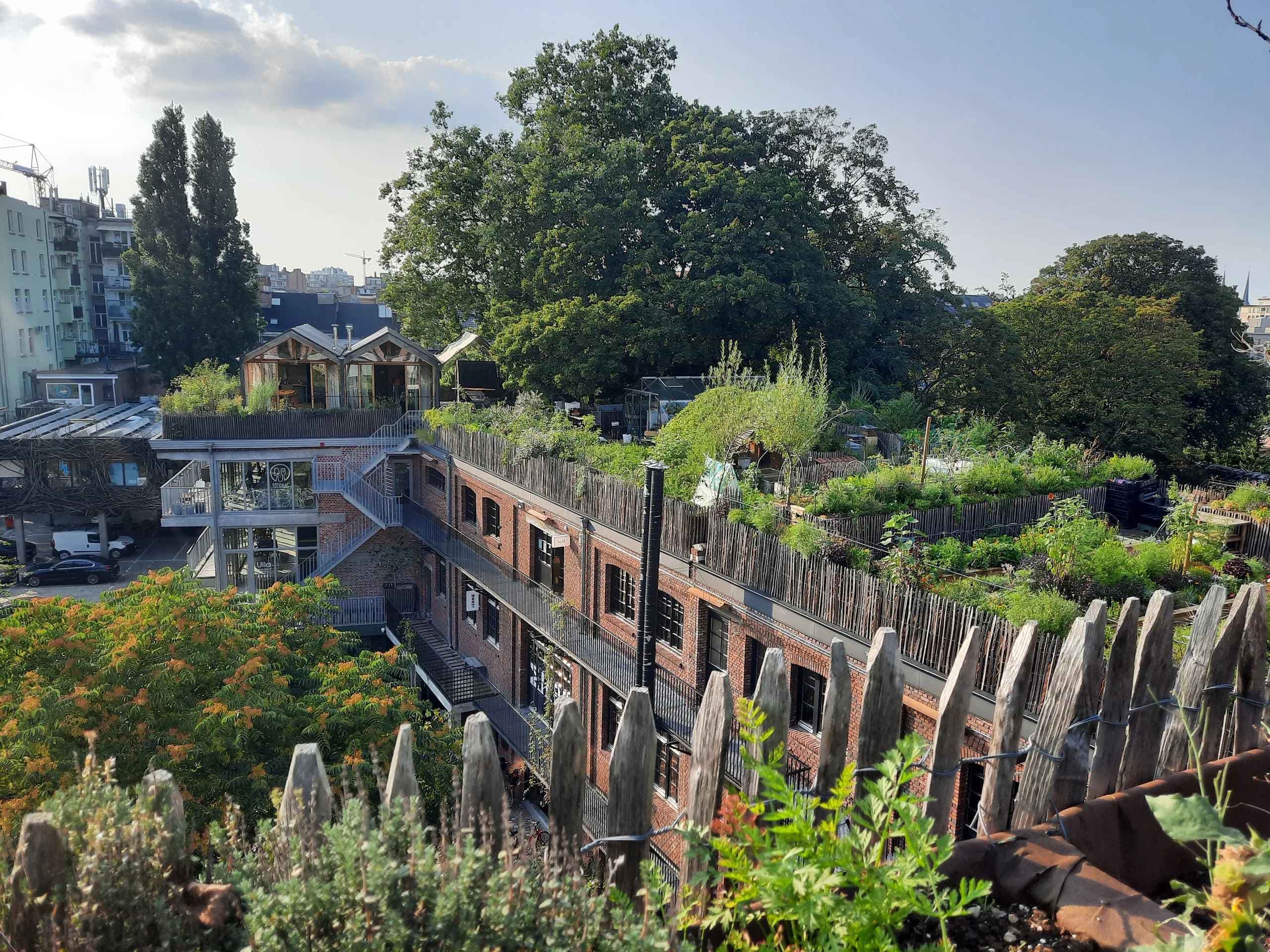
Our proven reference point is PAKT in Antwerp, where a derelict industrial site was transformed into a working rooftop farm. We're currently building out the model at Kruitfabriek in Vilvoorde, demonstrating that this works across different urban contexts, not just one showcase location.
What this means for your business specifically
If you're running a hospitality or food service business, a rooftop farm gives you something no marketing budget can manufacture: genuine local provenance. Herbs and vegetables grown on your own roof, served in your kitchen, with a story your customers can physically visit. That's a different category of sustainability claim.
For your employees, it's a tangible engagement point. Our nature restoration approach consistently shows that people exposed to working green spaces report lower stress and stronger connection to their workplace. A rooftop farm gives your team something to participate in, not just observe. Research published through the RESILIO project confirms that urban greening raises environmental awareness among city residents, which compounds over time into stronger community identity around your site.
For ESG reporting, the biodiversity gains from a rooftop farm are measurable. Pollinator counts, species diversity, stormwater retention volumes, local food production quantities. These are real numbers you can put in a sustainability report, not narrative statements about commitment to the environment.
The question we hear most from operations managers and property leads is: "Who actually runs this after it's built?" That's the right question. Our model is managed, not handed off. You don't need in-house urban farming expertise. You need a partner who handles the design, build, and ongoing management while keeping you connected to the output and the story. That's exactly what our full service portfolio is structured to deliver.
Is your roof actually suitable for urban farming?
Most flat urban roofs are candidates. The structural assessment is the starting point, not the barrier. Load-bearing capacity, drainage, access, and local planning permissions are the variables that shape the design, not questions that rule it out.
The critical design principle, confirmed by rooftop ecology specialists, is that the system needs to connect to the broader urban ecosystem to deliver its full biodiversity value. A rooftop farm that functions as an isolated island has limited ecological impact. One that's designed as a node in the city's green corridor network, visible to and accessible from the surrounding neighbourhood, multiplies its value significantly. This is why location and context matter in the initial assessment.
For businesses interested in combining rooftop food production with broader land-based sustainability commitments, rooftop farming pairs naturally with ground-level biodiversity work. Our approach to creating biodiverse habitats on company land follows the same design logic: intentional, measurable, and connected to the wider ecosystem rather than isolated.
The business case in plain terms
The objection we hear from SME owners is almost always about budget and complexity. Both are legitimate concerns. What shifts the calculation is understanding what you're actually getting in return.
A rooftop farm converts a liability (a maintained but unproductive roof surface) into an asset that generates food, generates PR value, generates employee engagement, and generates measurable ESG data. For a hospitality business, the local provenance story alone has documented commercial value. For any business with sustainability commitments, the ability to point to something physical and measurable is worth considerably more than another policy document.
The complexity concern resolves when you work with a partner who has already solved the technical and operational problems. We have. PAKT happened. Kruitfabriek is happening. The model is proven, the expertise exists, and the question for your business is simply whether your roof is the next site.
A rooftop farm is the most direct way to turn an unused urban asset into a functioning biodiversity system that also produces food, engages your team, and gives your sustainability story something real to stand on. To find out whether your rooftop is viable and what a managed farm could look like for your specific site, start a conversation with our team.
Frequently asked questions
Can a small urban rooftop actually make a meaningful difference to city biodiversity?
Yes. Even a modest rooftop farm creates habitat layers that urban ground-level spaces rarely provide. Pollinators, birds, and insects benefit from the combination of varied food crops, native supporting plants, and designed habitat features like nest boxes and insect hotels. When multiple rooftops in a neighbourhood are activated, they function as connected green corridors, which research from the RESILIO project confirms significantly amplifies ecological impact compared to isolated green patches.
What structural requirements does a rooftop farm need?
The key variables are load-bearing capacity, drainage infrastructure, access for maintenance, and local planning permissions. Most flat urban roofs in commercial buildings are candidates once a structural assessment is completed. The assessment shapes the design, it doesn't typically rule out the project. Substrate depth, irrigation systems, and planting choices are all calibrated to what the roof can carry, so the starting point is always a site-specific evaluation rather than a generic specification.
Who manages the rooftop farm once it's installed?
In a managed model like ours, the operator handles ongoing maintenance, crop management, and ecological monitoring. The business owner gets the output and the story without needing in-house urban farming expertise. This is the critical distinction between a managed rooftop farm service and a DIY installation: the former is designed to run without specialist staff on your payroll.
How do I measure and report the biodiversity impact for ESG purposes?
Rooftop farms generate several measurable outputs: pollinator species counts, plant diversity indices, stormwater retention volumes, and local food production quantities. These translate directly into reportable ESG metrics. Scientific monitoring built into the project design, rather than added retrospectively, is what makes the data credible to external stakeholders and auditors.
Is rooftop farming just greenwashing with extra steps?
No, provided the system is designed and managed properly. The difference between greenwashing and genuine impact is measurability and ecological function. A rooftop farm that integrates varied planting, habitat features, and livestock into a managed system produces verifiable biodiversity outcomes. A green roof with a few planters and a press release does not. The design intent and the ongoing management are what determine which category a project falls into.
What's the difference between a rooftop farm and a standard green roof?
A standard green roof, typically sedum-based, provides basic insulation and some stormwater retention. It supports limited biodiversity because of its monoculture planting and lack of structural habitat features. A rooftop farm adds food crop production, varied planting with different bloom cycles, deliberate habitat infrastructure (nest boxes, water features, insect hotels), and often livestock integration. The result is a significantly more complex ecosystem that supports a wider range of urban wildlife while also producing food and generating a tangible sustainability narrative.
Sources
- RESILIO Project, 2021 — European blue-green roof research demonstrating biodiversity and food production co-benefits on urban rooftops.
Share this post
Forest Forward Team
Stay up to date with our latest insights
Related articles
Real CSR activities for companies beyond team events
CSR activities are the concrete initiatives a company runs to create social, ecological or ethical impact beyond its core business, from volunteering and local community projects to nature restoration, sustainable sourcing and education. A fun day at a go-kart track is not one of them.
Sustainable business examples: 5 real cases from Belgian companies
Looking for proof that sustainability works beyond a slide deck? Here are 5 Belgian companies making it visible, measurable and real.
Sustainable business practices: a practical guide for 2026
Sustainable business means running your company with people, planet and profit weighed together, not profit alone. Here's how to actually do it.