
Outdoor team building activities: practical formats with real impact

Forest Forward Team
01-07-2026
•We see this constantly in our work with HR and sustainability managers at mid-to-large Belgian companies: the brief starts with "we want something meaningful outdoors" and quickly splits into three separate asks. HR wants stronger team cohesion. The CSR manager needs something that feeds into ESG reporting. Communications wants content that actually looks credible. The good news is that the right outdoor format delivers all three at once. The challenge is knowing which format to choose, and why.
This is a practical guide to the formats that work, what each one produces, and how to match the activity to your team size and business goals.
What makes an outdoor activity genuinely impactful?
An outdoor team activity has real impact when it produces a concrete, local result that your team can see, feel, and communicate. Three conditions need to be in place: the activity creates something tangible (trees planted, waterway cleaned, garden beds built), it connects to a local ecosystem or community that benefits directly, and it leaves participants with a story worth telling.
Generic outdoor challenges, rope courses, and scavenger hunts can be fun, but they produce nothing beyond the experience itself. Belgian companies in 2026 are increasingly looking for more. They want the afternoon to count twice: once for the team, once for the world outside the office.
Forest restoration and tree planting: the ESG anchor
Forest restoration is the strongest format for companies that need measurable ESG output alongside team cohesion. The activity is physical, collaborative, and produces a result you can quantify down to the individual tree.
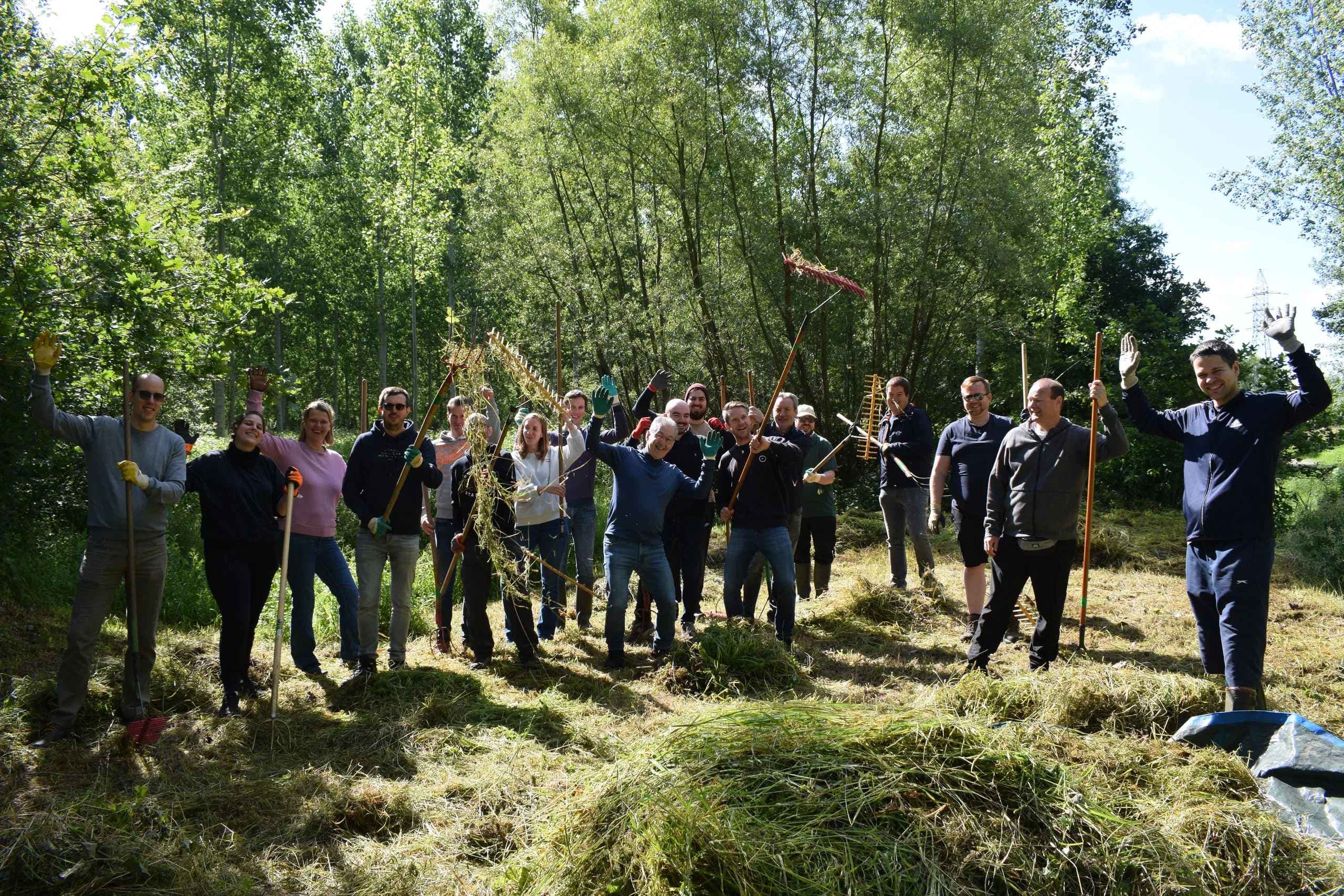
In practice, teams are split into subgroups and work alongside ecologists or nature guides to plant native species, clear invasive vegetation, or restore degraded forest edges. The physical work creates natural collaboration, decision-making under mild pressure, and shared effort without requiring athletic ability. It's inclusive for mixed-age, mixed-fitness groups.
For your sustainability manager, the output is concrete: number of trees planted, species diversity, hectares restored. For communications, the imagery is powerful and authentic. A team covered in mud, planting saplings in a Belgian forest, tells a more credible sustainability story than any infographic. For HR, the shared physical challenge and the visible result generate exactly the kind of pride and belonging that survey-based engagement programmes rarely achieve.
This is the format at the core of our impact events for corporate teams, where we connect companies directly with nature organisations and ensure every session produces lasting, local results.
Guided nature walks: the well-being and connection format
Guided nature walks work best when the goal is psychological reset, informal connection, and engagement rather than visible ESG output. Don't underestimate this format, but don't oversell it as an impact activity either. It sits in a different category.
What makes a nature walk more than a stroll is the structure. Observation assignments, reflective questions, expert-led interpretation of the local ecosystem, or even a sustainability walk tied to your company's ESG strategy — these elements transform a walk into a meaningful shared experience. Teams that rarely talk outside of meetings start talking differently when they're moving through a forest.
For HR managers dealing with post-restructuring tension, hybrid fatigue, or onboarding challenges, a well-designed nature walk creates the informal exchange that no workshop room can replicate. Pair it with a short impact activity at the end and you get both the connection and the tangible result.
Our sustainability walks and talks are built on exactly this principle: expert-led, nature-based, and tied to your company's specific ESG narrative rather than a generic outdoor experience.
Waterway and nature cleanups: fast results, strong communication content
Cleanup activities are the most immediately communicable format available. The results are measurable in minutes: bags of waste collected, metres of riverbank cleared, kilograms of plastic removed. That simplicity is a feature, not a limitation.
For a communications or marketing manager who needs before-and-after content, cleanup formats are unbeatable. The visual contrast is stark, the team is visibly active, and the local community benefit is undeniable. For a sustainability manager, the data is easy to capture and easy to slot into an ESG report.
Cleanup activities also scale well. Large groups of 80 to 200 people can be deployed across a waterway or nature reserve in subteams, each covering a defined zone. The competitive element (which team collects the most?) adds energy without requiring physical fitness. Because the format is straightforward to explain, it lands well with employees who are sceptical of "corporate teambuilding" as a concept. There is nothing abstract about picking up plastic from a river.
The key is choosing a location with genuine local relevance. A cleanup in a nature area near your office or production site carries more weight internally and externally than one in a generic location with no connection to your business.
Community gardens and urban food projects: the long-term engagement format
Community garden and food forest projects are the right choice when you want recurring involvement rather than a single event. A one-day build or planting session at a community garden can stand alone, but the format's real strength is repeatability.
Teams that return to the same garden across seasons develop a different relationship with the project and with each other. The garden becomes a shared reference point. New employees can be introduced through it. Progress is visible every time you visit.
For companies that want genuine local embeddedness, this format also builds relationships with neighbourhood organisations and social enterprises in a way that a one-off event cannot. It fits naturally into a broader sustainable team experience programme where the company commits to a cause over time rather than ticking a box.
How to match the format to your goals and group size
The right format is determined by four variables. Work through them before you brief a provider.
- Primary goal: If ESG metrics and reporting are the priority, choose forest restoration or cleanup activities. If team cohesion and well-being are the priority, choose guided nature walks or garden projects. If employer branding content is the priority, combine a visible impact activity with a photogenic natural setting.
- Group size: Cleanup and planting formats scale to large groups through subteam structures. Guided walks and garden projects work better for groups under 60, where the quality of interaction matters more than logistical throughput.
- Physical inclusivity: Forest restoration and garden projects require moderate physical effort but no athletic ability. Walks can be adapted to any fitness level. Cleanups are the most flexible across age and ability ranges.
- Communication output: If your team needs content for internal channels, client communications, or ESG reporting, choose a format with a clear before-and-after result. Measure it. Photograph it. Quantify it. Our article on how to measure the impact of team events walks through exactly how to capture that data.
What separates a real impact day from a branded outing
The difference between a genuine impact day and a well-packaged outdoor outing comes down to what remains after the team goes home. A real impact day leaves something behind in the landscape, the community, or the organisation it partnered with. It also leaves something behind in the team: a shared memory anchored to a specific place and a specific result.
If you are considering how to run this well end-to-end, our article on corporate volunteer events covers the operational and partnership side in detail.
The format you choose is the strategy: pick it based on outcomes, not aesthetics. With that clarity, you can brief your provider, set expectations with your team, and walk away with results that belong in your ESG report and your employer brand story at the same time. Explore our impact event formats and request a tailored programme for your team size, location, and goals.
Frequently asked questions
What outdoor team building activities produce measurable ESG results?
Forest restoration, tree planting, and waterway or nature cleanups are the formats that produce the clearest ESG metrics. They generate quantifiable outputs: number of trees planted, kilograms of waste collected, metres of habitat restored. These figures can be reported directly in sustainability documentation and communicated to stakeholders. Activities like guided nature walks or mindfulness sessions have well-being value but do not produce the same kind of measurable environmental output, so they are better positioned as engagement or cohesion activities rather than ESG deliverables.
How do I choose the right format for a large group?
For groups above 60 people, formats that divide naturally into subteams work best. Cleanup activities, tree planting, and forest restoration all scale through parallel subteam deployment across a defined area. Each subteam has its own task, its own zone, and its own measurable result, which keeps engagement high across the full group. Guided walks and garden projects require more facilitation per participant and are better suited to smaller groups where the quality of interaction is the primary goal.
Can outdoor team activities count towards our company's sustainability reporting?
Yes, provided the activity is structured to capture the right data. Quantified outputs such as number of trees planted, species restored, kilograms of waste removed, or square metres of habitat cleared can be included in environmental or social impact reporting. The key is choosing a partner who tracks and documents these results formally and connects the activity to a recognised local nature or social organisation. A one-off branded outing without data capture does not qualify.
What is the difference between a team building activity and a corporate volunteer event?
The distinction is primarily about structure and intent. A team building activity is designed first for the team: cohesion, engagement, and shared experience are the primary outcomes, and social or environmental impact is secondary. A corporate volunteer event is designed first for the beneficiary organisation: the team's contribution creates a real result for a nonprofit, nature project, or community initiative, and team cohesion is a positive side effect. The best outdoor formats for Belgian companies in 2026 deliberately combine both, so neither goal is compromised.
How long does a typical outdoor impact day take?
Most outdoor impact formats run between three and six hours, including travel within the site, briefing, activity, and a closing reflection. A half-day format of three to four hours works well for cleanup and planting activities. A full day allows for a richer combination of formats, for example a guided nature walk followed by a restoration activity and shared meal. The right duration depends on your group size, travel logistics, and whether you want to include catering or a debrief session.
Do we need to organise the partner organisation ourselves?
No. Working with a provider who maintains existing partnerships with social organisations, nature centres, and local nonprofits is significantly more efficient and more reliable. Established partnerships mean the beneficiary organisation is prepared, the activity is properly scoped, and the impact is genuine rather than improvised. It also ensures fair compensation for the partner, which is a basic condition for calling the activity meaningful rather than extractive.
Share this post
Forest Forward Team
Stay up to date with our latest insights
Related articles

Corporate social responsibility programs that actually work
A CSR program only pays off when it's structural, measurable and tied to daily operations, not a one-off gesture that ends the moment the photos are posted.

Volunteer team building: can your company outing be a volunteer action?
Yes. Not as a side activity bolted onto a normal team day, but as the team day itself, with the volunteer work as the main event.
Team building tree planting days: how to make it a real team event, not just a donation
You can run a company tree planting day that is both a genuine team building experience and a real environmental project, but only if you design the day around your people, not just around the trees.